
Build It and Some Will Come
What Do We Do When Innovation Isn't Innovating for Everyone?

I’ve had this strange and new feeling that has been very present for the past two weeks. I’ve been feeling it without naming it, and I think subconsciously connecting points to arrive at a “Ah, this is it.” Leaving behind. Has any author or philosopher explored this theme? You can possibly feel guilt in it. You can also not feel guilt but instead resentment. Despondency. Is acceptance the final stage?
After traveling for quite a bit, I’ve been in LA for sun, rest, and love from my nephews. Real luxury. And one day I went for a walk with my best friend, walking through West Hollywood and into Beverly hills. I kept in stride with her steps and recounting of the holidays while noticing a robot-controlled contraption passing by us on the sidewalk. Keeping my step, I turned around to watch it wait for a green light before crossing the street. Impressive, I thought. Some other sentiment nagged at the edges of my awareness.
Another day, driving with my brother, we pass by a driverless Waymo car. We both want to try it soon. It’s a little thrilling seeing all this new tech. It’s different from when you read about driverless cars to seeing them. You marvel at all the time and development (and your data) it probably took to create that.
Sorry, didn’t record when one actually crossed the street with me. 🙃
Build it and they some will come.
I ran across an article last week in the NYT about how telehealth services for digital mental health platforms are booming, but only for groups of people who already had access to mental health services. As the article states, that’s people in higher-income brackets, living in cities, with steady employment and more education.
“In fact, the researchers found, the shift to tele-therapy has exacerbated existing disparities.”
Damn, I thought. For all its forward thinking, this boom in telehealth therapy has not just maintained the status quo but exacerbated existing disparities.
This made me wonder who the targeted audience for these companies were for. In the meetings for funding, who were they showing as the prime candidate. Was the exclusion so intentional or did we get it wrong somewhere else.
Telehealth services for mental health came out in the 1990s with the intent to reach those in remote locations or areas where there was a dearth in mental health professionals. Providing mental health services, primarily therapy, over video and phone was seen as innovative. Patients could access mental health professionals remotely, thus improving access to care, especially for those living in remote areas. The ability to receive care from home was also seen as convenient and an innovative way in increasing patient engagement and adherence. Value add after value add.
When the COVID pandemic hit, these services surged, proving how vital digital healthcare could be. But as demand grew, the supply did not. There weren't enough therapists to meet demand, and not only that but there was a lack of proper training in how to practice remotely. So, there’s limited supply with limited training and limited groups having access to these services.
Lack of access, and especially lack of mental health professionals, is honestly something I hadn’t considered before. When working, I’d always tell my peers to utilize the mental health benefits our job offered us. Use it to help with the stress of work and if you’re lucky not to have that, use it for more personal reasons. I thought it was great to have this benefit (and I still do) and that I was wise to use it, not thinking anything beyond that until now. Damn, I thought. Here was an innovative idea—right? Telehealth for mental health—in that it was increasing access to care and providing convenience and flexibility. A true technological advancement. From one angle it looks successful; yet from another angle, mental health professionals are not properly equipped, while another angle shows mental telehealth services as only reaching those who would go in person anyway. So what am I saying? That innovation can have blind spots. It can appear glam from one angle but from another, it’s a desert of people still desperately needing mental health, and left behind.
Paradoxically, technology gives us access and connection, while creating disconnection and exclusion.
This leaving behind theme is on a global scale I see, but also within societies. Every day I read about how one company has surpassed another company in their AI capabilities or a Youtube video on how to learn everything about a new AI tool in 10 minutes. It’s a constant go go go. There’s so much out there to take in. You could go offline for a month and come back and the world of tech would be vastly different. Some AI company would have supplanted another with the most powerful LLM, another would have created a newer AI tool to act as you on a call, and we would have moved on from generative AI to something else. The internet came out and opened up worlds to access and connection. It also still left millions of people in the dark, creating a digital divide that we’re only seeing again with the emergence and stickiness of AI.
Lauren Berlant’s concept of “cruel optimism” comes to mind. As a society, we maintain this attachment that new technology will solve all our problems. While these advances do create real benefits, this optimism becomes cruel because the very progress we’re so sure about too often just deepens existing inequities.
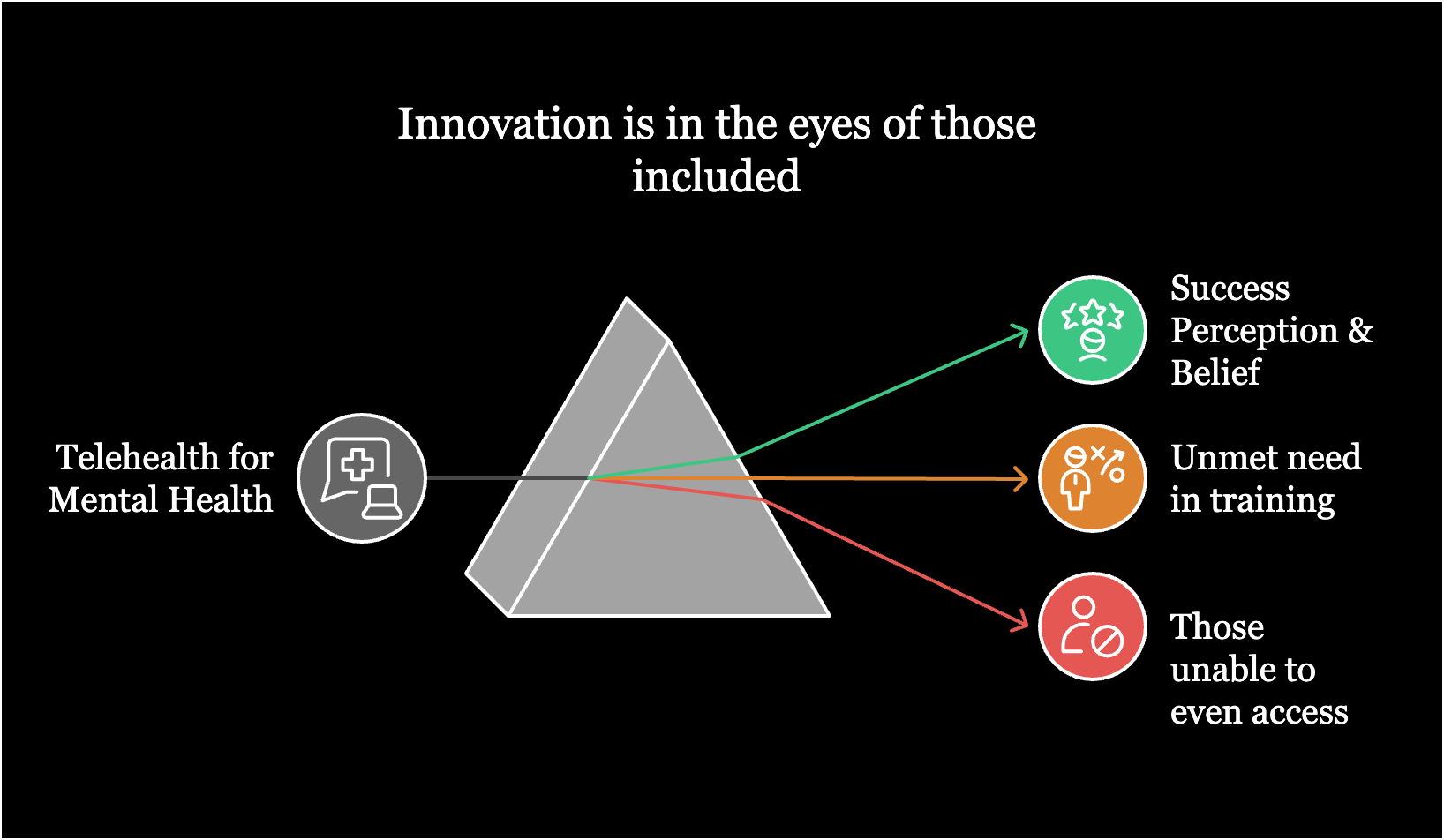
I’m not arguing that we all need automated carts to deliver convenience goods. But I’m witnessing in real time innovative services and products that are maintaining social status quo gaps. New things are being created but nothing’s really changing. What if the next big thing we create benefits humanity as a whole? It’s like instead we’re complacent with taking a rough diamond of an idea, sharpening it to shine on one side that benefits some, while content about the other sides staying as is. If we’re being innovative, maybe this is failing then.
Is there such a thing as inclusive innovation? Take telehealth services - it isn't the answer for all those going through a mental health crisis. It’s not the solver of everything. But it's a valuable resource that should reach beyond just the corporate girlies and white-collar types, beyond those who grew up with therapy as just another part of healthcare, like annual check-ups and dental visits.
Will I eventually forget this feeling that leaving behind brings or will it stay with me? Will it drop off my shoulder or can it be molded into a tool. Either way, it’s a heavy one to tote. So maybe the last stage is acceptance. But not in complacency, but in ability to leverage. Let’s see.
Yup. Build it for those you already had in mind, and they will show up at your virtual front stoop! The glove already fits, you ain't gotta aquit! The innovators are not pleading not guilty here...they know.